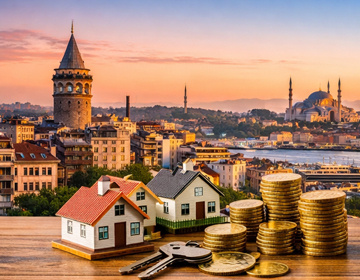

Turkey processed approximately 1.5 million residential property sales in 2025 — and until now, a significant portion of those transactions involved the physical handover of cash at the land registry office. Stacks of banknotes changing hands in government corridors, buyers arriving with briefcases, sellers counting bills on the spot. That era ends on July 1, 2026. The Turkish Ministry of Trade has formalized a mandatory Secure Payment System for all real estate transactions, modeled on the escrow mechanism already operating successfully in Turkey's second-hand vehicle market. For foreign investors evaluating Istanbul property right now, this single regulatory shift materially changes the risk calculus — and not in a negative direction.
What Is the Secure Payment System and Why Does It Matter?
Effective July 1, 2026, every residential and commercial property sale in Turkey that involves cash or electronic funds transfer (EFT/wire) must route payments through a state-integrated secure payment platform. The core mechanic is straightforward: buyer funds are placed into an escrow-style holding account at an authorized financial institution. Those funds are released to the seller only after the title deed transfer is officially recorded in the land registry system. The two events — money moving and ownership changing — happen simultaneously, not sequentially.
For transactions involving bank financing, the regulation still applies to the portion of the purchase price that exceeds the loan amount. In other words, if a buyer secures 60% financing and pays 40% from personal funds, that 40% must flow through the secure payment channel. The applicable service fee is deducted directly from the sale proceeds credited to the seller — buyers do not pay it separately at closing. A joint oversight commission drawn from representatives of the Ministry of Environment, Urbanization, and Climate Change provides technical supervision and handles dispute resolution during the transition period. The legal basis for this system was formally established through a regulation amendment published in Turkey's Official Gazette on April 29, 2026.
💡 Opportunity Angle: Investors who have been monitoring Turkey from the sidelines due to transaction transparency concerns now have a concrete, institutional answer to their objections. The window between this announcement and full implementation is precisely the moment to act — before broader market confidence drives prices higher across sought-after districts.
The Problems This Regulation Directly Solves
Corporate Property Ownership in Turkey: What Foreign Companies and Investors Must Know in 2026 Turkey Property VAT Exemption 2026: How Foreign Investors Save Up to 20% on Real Estate Purchases High-End Family Residences Near Metro & Financial CenterAnyone who has completed a property purchase in Turkey before 2026 will recognize the friction points this system eliminates. Physical cash transactions at Turkish land registry offices created genuine exposure: counterfeit currency risk, arithmetic errors during counting, theft risk when transporting large sums, and the documented but rarely discussed problem of sellers or intermediaries disappearing between payment and title transfer. For foreign buyers unfamiliar with local customs, these risks were amplified by language barriers and limited local networks.
Unregistered or under-declared transaction values — a practice that distorted both buyer protection and tax collection — are also directly targeted by this system. When funds flow through a regulated escrow channel, the declared sale price is automatically the transacted price. There is no longer a structural incentive to misrepresent values. This brings Turkish real estate closer to the transactional standards that international investors expect from markets like the UK, Germany, or Australia. For Domirel clients, this has been a frequent conversation: in our recent client transactions, we are seeing that buyers from Western Europe and the Gulf who previously required extensive due diligence on payment mechanics are now moving faster, because the institutional framework removes a layer of negotiation they previously factored as risk.
For a deeper look at how due diligence works in Turkish property purchases, see our guide on Best Property Types for Investment in Turkey: Apartments, Villas, Commercial & Land (2026 Guide).
💡 Opportunity Angle: Buyers purchasing before July 1, 2026 under the existing system still benefit from experienced broker oversight. Those buying after benefit from the new institutional framework. Either way, Q2 and Q3 2026 represent a period of heightened market activity as transaction confidence rises.
How the Escrow Mechanism Works in Practice
Luxury Apartments with Bosphorus Views in Beşiktaş, IstanbulThe operational flow of the Secure Payment System is built around a digital platform that connects directly with licensed Turkish banks and authorized financial institutions. Here is the step-by-step sequence as it applies to a standard cash or EFT purchase as of July 2026:
- Step 1 — Buyer initiates transfer: The agreed purchase amount is transferred by the buyer into the designated secure payment account held at an authorized institution. The funds are ringfenced — neither party can access them during the interim period.
- Step 2 — Land registry processing: The title deed transfer is submitted and processed at the relevant land registry office (Tapu Müdürlüğü) in the standard way. The secure payment system is linked in real time to the registry's confirmation system.
- Step 3 — Simultaneous settlement: The moment the title deed transfer is officially recorded, the escrow funds are automatically released to the seller's designated bank account. There is no manual step, no delay, and no discretionary hold.
- Step 4 — Fee deduction: The platform service fee is deducted from the seller's credited amount. Fee structures are set by the Ministry of Trade and apply uniformly across transactions.
For bank-financed purchases, the lender's portion settles through existing mortgage disbursement channels. Only the buyer's equity contribution — the amount above the loan — must route through the secure payment platform. This creates a hybrid process that integrates seamlessly with Turkey's existing mortgage infrastructure without disrupting it.
💡 Opportunity Angle: Foreign investors purchasing remotely — a segment that has grown significantly since 2022 — benefit most immediately from this system, since the escrow mechanic provides the same protection as being physically present with legal counsel during every step of the transaction.
What This Signals About Turkey's Real Estate Market Direction
5+1 Duplex Lake View Villa in SapancaRegulatory maturity follows capital. Turkey's decision to implement mandatory escrow for real estate — using the exact model already proven in vehicle sales — is not an isolated policy event. It sits within a broader trajectory of institutional reform that includes mandatory energy performance certificates, updated foreign ownership title deed procedures, and tightening of construction compliance standards across Istanbul's major development corridors. Markets that build this kind of infrastructure attract the next tier of international capital, and that dynamic has a direct effect on pricing.
As of May 2026, prime residential property in Istanbul's established European-side districts is trading in the $4,500–$8,000 per square meter range, with new-build projects in well-connected Anatolian-side growth districts priced between $2,500–$5,000 per square meter. Rental yields in Istanbul are tracking between approximately 6–9% annually depending on district and property type — figures that continue to outperform equivalent asset classes in Western European capitals. This is precisely where expert local guidance becomes critical: identifying which sub-markets are pricing in future infrastructure premiums versus which are already fully valued.
Turkey's citizenship by investment threshold remains at $400,000 (unchanged since June 2022), making a single qualifying property purchase a direct path to Turkish citizenship. For investors evaluating this route, the new Secure Payment System adds an additional layer of transactional certainty to what is already a well-structured citizenship pathway. For a full breakdown of residency and citizenship options, see our guide on Istanbul Visa Requirements for Property Investors: Citizenship and Residency Paths.
💡 Opportunity Angle: Domirel advisors are currently recommending that citizenship-focused buyers move before anticipated policy revisions adjust the $400,000 threshold — a conversation that surfaces regularly in Ministry discussions as the market matures.
📍 Where Smart Investors Are Buying Now
As of May 2026, two districts dominate our active client transaction flow. Beşiktaş on Istanbul's European side continues to attract high-net-worth buyers who prioritize capital preservation and rental income from premium tenants. Prices in Beşiktaş are running between approximately $6,500–$10,000 per square meter for new-build stock, with branded residences commanding the upper end. Demand from corporate relocation tenants and diplomatic-community renters keeps vacancy rates low and yields stable. The Kiler GYO - Referans Beşiktaş project represents the kind of address-quality asset that holds value through market cycles — and with units ranging from $660,000 to $3,300,000, there are entry points across multiple investor profiles.
On the Anatolian side, Ümraniye is the district our team flags most consistently for growth-oriented investors. Metro connectivity, ongoing commercial infrastructure development, and a price point still approximately 35–45% below comparable European-side locations make it a genuine capital appreciation play over a 3–5 year horizon. New-build prices here are tracking in the $3,000–$5,500 per square meter range as of May 2026. The Verdant Aura Residences project in Ümraniye offers entry from $550,000, with larger units at $1,300,000 for investors targeting citizenship-qualifying thresholds in a high-growth corridor. Our on-the-ground team notes that the most sophisticated buyers right now are those pairing an Ümraniye purchase with a shorter-term rental strategy, capturing the yield while the capital appreciation plays out. For a district-level breakdown, see our detailed analysis on.
📊 Best Property Types in Current Market
The July 2026 Secure Payment System makes ready-delivery properties the immediate beneficiary in terms of transaction volume. Buyers who previously hesitated due to payment-process uncertainty will now transact more confidently on completed stock, and sellers of ready properties gain pricing power as buyer confidence rises. For investors focused purely on rental yield, ready 1+1 and 2+1 apartments in metro-accessible districts are generating approximately 6–8% gross annual yields as of May 2026, with furnished units in tourist-active neighborhoods tracking toward the upper end of that range.
Off-plan purchases remain the stronger play for pure capital appreciation, with typical developer pricing discounts of 15–25% below projected delivery-period market value in well-selected projects. The key filter is developer track record and construction financing structure — both of which Domirel vets before recommending any off-plan asset. For citizenship-by-investment buyers, the $400,000 minimum must be met by a single property or combination of properties; ready-delivery stock priced above this threshold in established districts offers both the citizenship qualification and immediate rental income activation. At Domirel, we help investors identify these windows before they close — the combination of new payment security infrastructure and existing citizenship thresholds creates a short-term convergence of conditions that will not persist indefinitely as more international capital prices in the regulatory improvements.
👤 Who Should Invest Now vs Who Should Wait
Long-term investors (5+ year horizon): Act now. The Secure Payment System is one of several structural improvements that will attract a broader international buyer pool to Turkey over the next 24–36 months. Entering before that demand wave is priced into the market is the classic value-add positioning. Districts like Ümraniye and Eyüp offer current pricing that has not yet reflected the full infrastructure premium. Investors who act during periods of regulatory maturation typically secure the best long-term deals — this is that moment in Turkey's market cycle.
Citizenship-by-investment buyers: The $400,000 threshold and the new transaction security framework create an unusually clean case for acting in H2 2026. There is no credible reason to wait unless you are actively comparing Turkey against specific alternative programs. With Portugal's property route closed and Greece's Athens threshold now at €800,000, Turkey remains the most accessible major citizenship program for real estate investors in the region. Process your purchase through the new secure payment system and you also have institutional documentation of the transaction value — which simplifies the citizenship application dossier.
Short-term speculators: Exercise caution and selectivity. Turkey's market has moved significantly since 2022, and the easy arbitrage plays in certain central districts have already been captured. The Secure Payment System itself does not create short-term price spikes — it creates medium-term confidence infrastructure. If your horizon is under 18 months, focus exclusively on ready properties in high-rental-demand locations where yield covers your carry costs while you wait for the right exit. This is not a market for low-conviction, short-duration trades in 2026.
Ready to Invest?
Domirel specializes in identifying undervalued opportunities and structuring smart investments. Whether you are a first-time buyer, seasoned investor, or exploring citizenship by investment, our advisors provide personalized guidance backed by real transaction data.
📞 +90 531 512 61 88 | info@domirel.com