Here is a counterintuitive fact about Istanbul: the city with some of the worst traffic congestion in Europe is also home to dozens of neighborhoods where owning a car is genuinely unnecessary. According to TomTom's 2025 Traffic Index, Istanbul ranks among the top five most congested cities globally — yet residents in districts like Cihangir, Moda, and Karaköy report spending less than 12 minutes on average reaching daily necessities on foot. For real estate investors, this creates a clear pricing signal: walkable, transit-rich properties in Istanbul command rental premiums of 20–35% above comparable car-dependent locations, as of May 2026. Understanding which neighborhoods offer this combination is not just a lifestyle question — it is a direct investment performance variable.
Why Walkability Matters for Istanbul Real Estate Investment
Istanbul's urban geography divides naturally into two categories: high-density, mixed-use historic neighborhoods where everything is within walking distance, and sprawling suburban developments built entirely around private vehicle use. The former consistently outperforms the latter in rental yield and capital appreciation. In our recent client transactions, we are seeing tenants — particularly expatriates, digital nomads, and young professionals — paying a clear premium for apartments within 500 meters of a metro, tram, or ferry terminal combined with walkable retail and dining.
The data supports this pattern. Walkable districts in Istanbul's European side have recorded price appreciation of approximately 18–25% in USD terms over the past 18 months, as of May 2026, outpacing the broader Istanbul average. Rental yields in these areas typically fall between 5–8% gross annually, sitting comfortably within Istanbul's standard 5–9% range. For investors targeting short-term rentals through platforms like Airbnb, walkable central neighborhoods routinely achieve occupancy rates above 75% annually — a critical threshold for profitable vacation rental operation.
Opportunity Angle: Investors targeting the short-term rental market should focus acquisition budgets specifically on districts within this guide — the rental premium over suburban alternatives is large enough to meaningfully improve net returns.
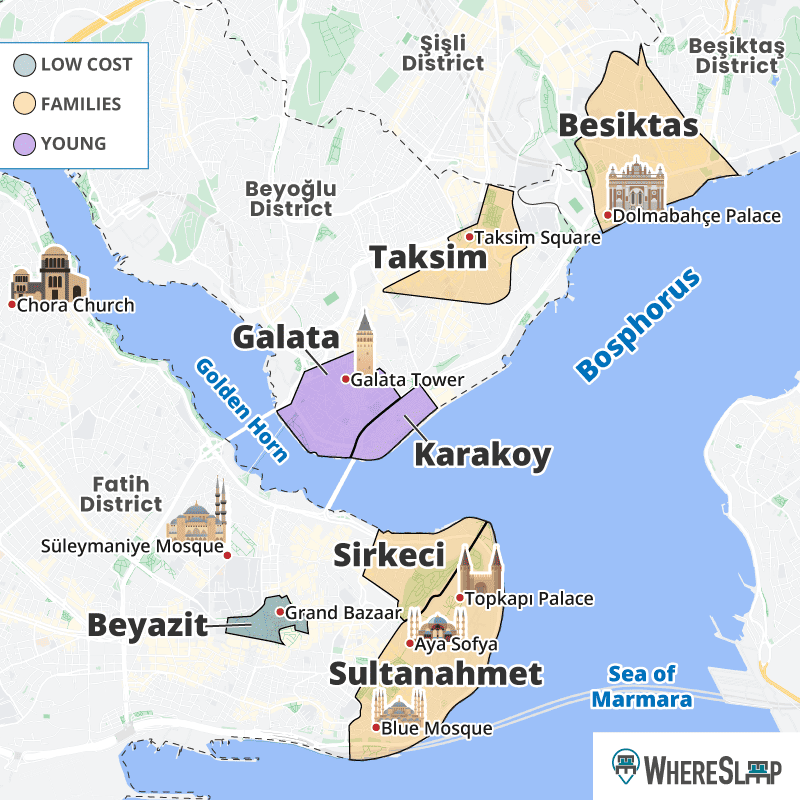
The Historic Peninsula: Fatih, Sultanahmet, and Gülhane
Modern Apartments in Central Istanbul - A Sustainable, Luxurious and Investment-Worthy Living Environment — $1,475,000The Historic Peninsula, anchored by the Fatih district, represents Istanbul's most compact and historically layered walkable environment. Within Sultanahmet alone, a resident can reach Hagia Sophia, Topkapı Palace, the Basilica Cistern, and the Grand Bazaar entirely on foot within 15–20 minutes. The street grid here was designed centuries before automobiles existed, which means the entire quarter functions as a natural pedestrian zone. Daily essentials — groceries, pharmacies, cafes, clinics — are embedded within the fabric of the neighborhood rather than concentrated in distant retail parks.
Public transport connectivity reinforces this pedestrian character. The T1 tram line runs directly through Sultanahmet and connects westward toward Bağcılar and eastward to Kabataş, where ferry and funicular connections extend the network further. Metro stations at Vezneciler and Aksaray provide rapid connections to the broader city. For investors, the Fatih district offers one of Istanbul's most interesting price-to-location ratios. Properties in Fatih currently trade at approximately $2,500–$4,500 per square meter, as of May 2026, which is meaningfully below the pricing of equivalent centrally-located properties in Beşiktaş or Şişli. Projects like — positioned at entry points from $400,000 — offer investors a route into a UNESCO-adjacent location at prices that still allow for healthy yield generation.
Gülhane Park, adjacent to Sultanahmet, adds material quality-of-life value to properties in the surrounding streets. Its shaded walking paths, direct access to the Bosphorus waterfront promenade, and proximity to Sirkeci ferry terminal make the immediate area one of the most genuinely liveable pockets of the European city center. This is precisely where expert local guidance becomes critical — differentiating between streets with strong rental demand and those where occupancy is more seasonal requires on-the-ground knowledge that aggregate data cannot provide.
Opportunity Angle: Investors targeting Turkey's $400,000 citizenship by investment threshold will find Fatih-based new development projects a practical entry point that simultaneously qualifies for citizenship and generates competitive rental returns.
Beyoğlu, Galata, Karaköy, and Cihangir: The Creative Core
Flats with family concept in Camlica region of Istanbul — $3,485,000If Sultanahmet is Istanbul's historical anchor, Beyoğlu is its social engine. The Galata–Karaköy–Cihangir corridor on the northern bank of the Golden Horn is the neighborhood cluster most consistently cited by international residents when asked where they live without a car in Istanbul. The topography here is steep — the neighborhood climbs from the waterfront at Karaköy up through Galata tower and into the residential streets of Cihangir — but the reward for walking is a density of independent cafes, galleries, restaurants, and markets that few city centers in Europe can match at this price point.
Karaköy functions as the transit hub for this cluster. The Karaköy tram stop on the T1 line, combined with ferry terminals serving both Asian and European shore destinations, means a resident here can reach virtually any part of the metropolitan area without a vehicle. Cihangir specifically — a neighborhood of 19th-century apartment buildings, steep cobblestone streets, and a large expatriate community — has become one of Istanbul's most tightly contested rental markets. One-bedroom apartments here routinely achieve monthly rents of approximately $800–$1,400, as of May 2026, generating yields that reward investors who purchased before 2023.
Domirel advisors are currently recommending Beyoğlu-adjacent properties to clients who prioritize short-term rental income over immediate citizenship qualification. The neighborhood's proven international appeal means vacancy risk is lower than in emerging districts, even if entry prices are higher. For those seeking a higher-end entry into this zone, represents a positioned product within the walkable north European side.
Opportunity Angle: Investors who act during market corrections typically secure the best long-term deals — and with some Beyoğlu properties having adjusted 8–12% from 2024 peaks, selective buying now positions portfolios well ahead of the next demand cycle.
Nişantaşı and Beşiktaş: Upscale Walkability on the European Shore
New Residential Project Offers Uninterrupted Forest View in the Heart of Istanbul's New Center — $1,352,941For investors targeting Istanbul's premium residential market, Nişantaşı and Beşiktaş represent the intersection of walkable urban living and high-end property values. Nişantaşı — often compared to Paris's 8th arrondissement or Milan's Brera — is a grid of wide, tree-lined boulevards housing flagship international brands, fine dining restaurants, and private clinics. The neighborhood functions almost entirely on foot for daily life. Residents walk to their gym, their grocery store, their pharmacy, and their children's school without ever requiring a vehicle.
Beşiktaş extends this walkable character toward the Bosphorus waterfront. The Beşiktaş ferry terminal, combined with the Gayrettepe metro station just inland, gives residents of this district arguably the best multimodal transit access in Istanbul. Property prices here reflect this premium: residential units in central Beşiktaş currently trade at approximately $4,500–$8,000 per square meter, as of May 2026. New development projects in the district — like the project, with units from $660,000 — target buyers who want Bosphorus-proximate living with institutional-grade build quality. For those seeking larger formats, — positioning squarely within the upper tier of Istanbul's luxury market.
Our on-the-ground team notes that the most sophisticated buyers right now are prioritizing Beşiktaş and Nişantaşı for capital preservation — the combination of low supply growth, sustained international demand, and premium infrastructure makes these districts the most defensible positions in Istanbul's property market during any volatility cycle.
Opportunity Angle: High-net-worth buyers targeting Turkey's $400,000 citizenship threshold will find multiple qualifying entry points in Beşiktaş new developments, with the added benefit of holding an asset in one of the city's most liquid resale markets.
Moda and Kadıköy: The Asian Side's Walkable Alternative
Any serious analysis of car-free living in Istanbul must include the Asian side — specifically Kadıköy and its elegant southern extension, Moda. These two neighborhoods consistently rank among Istanbul's most liveable by quality-of-life surveys, and for good reason. Kadıköy has a complete urban ecosystem within walking distance: a covered market, independent bookshops, dozens of restaurants and bars, fresh produce markets running six days a week, and a bull statue at its main square that has become one of the city's most recognized meeting points.
Moda, extending south from Kadıköy along the Marmara coastline, is a lower-rise, more residential expression of the same walkable character. Streets here are calmer, tree cover is stronger, and the seafront promenade offers a daily walking route that connects to Fenerbahçe Park — one of Istanbul's finest green spaces. Property prices in Kadıköy and Moda currently range from approximately $3,000–$6,000 per square meter depending on building age, floor level, and proximity to the waterfront, as of May 2026. The area attracts a strong domestic rental market from young professionals and university graduates, keeping vacancy rates consistently low and supporting yields in the 5–7% range.
For investors comparing European and Asian side options, the Asian side currently offers a relative value discount of approximately 15–25% against equivalent European side walkable districts — a gap that has been closing steadily as the Marmaray rail link and additional metro extensions improve cross-Bosphorus connectivity. To understand how the full range of walkable neighborhoods compares from an investment perspective, the guide provides district-by-district data.
Opportunity Angle: Investors willing to position on the Asian side today can capture both the yield advantage of a strong domestic rental market and the capital appreciation upside as the European-Asian price gap continues closing.
Balat and Eyüp: Emerging Walkable Districts with Growth Upside
Balat and Eyüp represent a different investment thesis within the walkable Istanbul narrative — not established premium, but early-stage gentrification with documented appreciation momentum. Balat, a historic neighborhood of painted wooden houses, Greek and Jewish heritage buildings, and steep streets dropping toward the Golden Horn, has been on every international publication's list of Istanbul's most photogenic neighborhoods since approximately 2019. That recognition has translated into tangible rental demand and rising property values, though entry prices remain materially below those of more established districts.
Eyüp, adjacent to Balat and anchored by the Eyüp Sultan Mosque complex, is further along a similar trajectory. New residential development here has been absorbed steadily by both local and international buyers. Projects like — with entry points from $350,000 — bring modern apartment specifications into a neighborhood that retains strong walkable character and is well-served by the Golden Horn ferry line connecting to Eminönü and Karaköy. At Domirel, we help investors identify these windows before they close — and in Balat and Eyüp, the window of sub-$400,000 entry into an internationally recognized, walkable Istanbul location is narrowing as demand continues building through 2026.
Opportunity Angle: Early-stage buyers in Eyüp are positioned for both rental yield (approximately 6–8% gross in well-managed short-term rental operations) and capital appreciation as the Golden Horn corridor continues its gentrification cycle.
Where Smart Investors Are Buying Now
As of May 2026, the highest conviction buy zones among Domirel's active investor clients are concentrated in three clusters. First, Beşiktaş new developments — particularly projects with Bosphorus proximity and institutional developer backing — are absorbing significant capital from Middle Eastern and European buyers seeking both citizenship qualification and long-term capital preservation. Price per square meter here ranges from $4,500–$8,000, and while yields are moderate at 4–6% gross, the resale liquidity and USD-denominated appreciation track record make this the safest risk-managed entry in the market. For citizenship buyers, the details exactly how the $400,000 threshold applies to specific property structures.
The second active cluster is the Fatih–Eyüp–Balat heritage corridor, where investors are acquiring both new developments and renovated period properties at $2,500–$4,500 per square meter. This zone benefits from UNESCO recognition, growing short-term rental demand, and infrastructure investment from the Istanbul Metropolitan Municipality. The third cluster — for investors with higher risk appetite and longer hold periods — is the Asian side, specifically Kadıköy adjacent neighborhoods where new metro extensions arriving in 2027 are expected to catalyze the next significant price adjustment upward. Positioning ahead of infrastructure delivery remains one of Istanbul's most consistently rewarding strategies, as documented repeatedly over the Marmaray, Metrobus, and various metro line completions of the past decade.
Best Property Types in Current Market
For walkable district investment in Istanbul as of May 2026, the property type selection matters as much as the location. Ready-to-deliver apartments in established walkable neighborhoods — Beşiktaş, Kadıköy, Cihangir — command a liquidity premium and generate immediate rental income, which is critical for investors who need cash flow from day one. Expect to pay $3,500–$8,000 per square meter for quality ready stock in these areas, with gross yields of 5–8% depending on management structure. Short-term rental operations in these districts, when professionally managed, can push effective yields toward 8–10% gross, though net figures after platform fees and management costs settle closer to 5–7%.
Off-plan purchases in emerging walkable districts — Eyüp, Balat-adjacent, and select Fatih projects — offer price advantages of 15–25% below anticipated completion value, but require 18–36 month hold periods before income generation. These are best suited to investors who do not need immediate yield and are specifically targeting capital appreciation or citizenship qualification at the lowest possible entry price. For citizenship-focused buyers, the $400,000 minimum applies to the declared title deed value — new development off-plan contracts can qualify provided the title deed reflects the required threshold at the time of registration. Two-bedroom apartments in the $400,000–$700,000 range within walkable central districts currently represent the strongest combination of citizenship eligibility, rental demand, and resale liquidity.
Who Should Invest Now vs Who Should Wait
Related Reading
Iranian Property Investors Moving to Istanbul from Dubai: Complete Investment Guide 2026 · Living Near Istanbul's Tech Hubs: The Smart Investor's Guide to Neighborhoods by Technoparks
Long-term investors (5+ year horizon): The case for buying now is strong. Istanbul property priced in USD has delivered positive real returns in 5 of the last 6 years for foreign currency holders. Walkable central districts are supply-constrained — there is no meaningful land for new development in Cihangir, Moda, or Sultanahmet — which creates structural price support. Investors with patient capital and a buy-and-hold orientation should be actively acquiring quality stock in the districts covered in this guide. The seasonal summer buying window — detailed in the — often produces 5–10% negotiation advantages over list prices.
Citizenship buyers: Act now with clear parameters. The $400,000 Turkey citizenship by investment threshold is current as of May 2026, but thresholds have a documented history of increasing — the move from $250,000 to $400,000 in June 2022 created significant urgency among buyers who delayed. Citizenship-focused buyers should prioritize new development projects in walkable districts with established title deed processes, institutional developers, and clear TAPU (title deed) delivery timelines. The combination of citizenship eligibility and walkable location maximizes both the personal utility and the resale value of the asset.
Short-term speculators: Exercise caution. Istanbul's market has shifted from the rapid quarterly appreciation cycles of 2021–2022 toward a more normalized growth environment. Investors expecting to flip properties within 12 months for significant gains will find the current market less accommodating than it was 36 months ago. This is not a negative signal for the market — it reflects a healthier, more sustainable demand-supply balance — but it does mean that speculative quick-flip strategies carry more execution risk today. If a short hold is required, focus on pre-construction projects from developers with proven delivery records, where the off-plan discount provides the built-in margin that the spot market no longer offers as freely.