Istanbul Outperforms: What the Numbers Say in May 2026
While European real estate markets have broadly stagnated — with Paris and Berlin recording near-flat price growth through late 2025 — Istanbul posted year-on-year price increases across its core districts, with fast-growing western neighborhoods delivering rental yields between 6% and 7% as of May 2026. Foreign buyer transactions in Turkey surpassed 35,000 units in 2025, a figure that reflects sustained international confidence, not a seasonal spike. For investors who track real returns rather than headlines, Istanbul has quietly become one of the most compelling property markets in the world.
What drives that confidence? A combination of structural factors: a city of approximately 16 million people that continues to grow, a tourism sector generating millions of annual arrivals, an economy that serves as the commercial engine of a country of 85 million, and property prices that — in emerging districts — still sit well below comparable cities in Eastern Europe, let alone Western capitals. The entry point and the upside are both still intact, which is increasingly rare in 2026.
Opportunity Angle: Investors entering emerging western districts like Beylikdüzü or Küçükçekmece today are positioned ahead of the infrastructure curve — metro expansions and canal-adjacent development are still being priced in.
Geographic Position: Why Istanbul's Location Is a Financial Asset
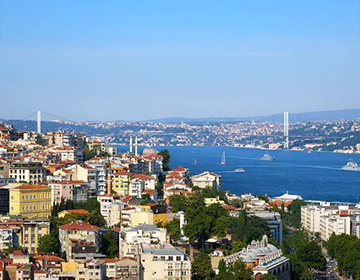
New Istanbul Property Investment Opportunity with Affordable Prices in Prime LocationIstanbul is the only metropolis on earth that physically spans two continents. That is not a marketing line — it is a commercial reality that shapes every aspect of the city's property market. Sitting at the junction of the Bosphorus Strait, Istanbul connects Europe, Asia, the Middle East, and North Africa within a single flight radius of three to four hours. Istanbul Airport, now consistently ranked among the highest-traffic aviation hubs globally, handles well over 80 million passengers annually and continues to expand capacity.
This geography directly influences property demand. Multinational corporations choose Istanbul as their regional headquarters precisely because of this connectivity. That corporate presence creates sustained demand for executive rentals, serviced apartments, and long-term leases in districts like Maslak, Levent, and Ataşehir — the city's financial corridors. Meanwhile, the Bosphorus corridor itself commands premium pricing, with waterfront and Bosphorus-view properties in Beşiktaş reaching $5,000–$9,000 per square meter as of May 2026, underpinned by irreplaceable scarcity. For buyers seeking that tier, Luxury Apartments with Bosphorus Views in Beşiktaş represent the kind of trophy asset that holds value through any market cycle.
Opportunity Angle: Corporate relocation demand in financial districts like Ataşehir creates a reliable long-term tenant base for investors targeting executive apartment segments. A 3+1 Apartment in Ataşehir starting from $486,000 sits directly in this demand corridor.
Economic Fundamentals and Demographic Growth
Prime Location Apartments in Gaziosmanpaşa: Live at the Heart of Istanbul's Urban TransformationIstanbul generates approximately 30% of Turkey's total GDP and hosts the headquarters of the country's largest banks, manufacturers, and exporters. Borsa Istanbul, the national stock exchange, anchors a financial ecosystem that draws regional capital from the Middle East, Central Asia, and Eastern Europe. This economic density creates a self-reinforcing cycle: business activity attracts talent, talent requires housing, and housing demand sustains both rental yields and capital values.
Population dynamics add further structural support. Istanbul's population has grown consistently over the past two decades, driven by internal migration from Anatolia and international arrivals from Russia, Ukraine, Iran, and the Arab world. Young professionals and university students are particularly mobile — and they rent before they buy, creating a deep pool of tenants across mid-market districts. In our recent client transactions, we are seeing consistent demand from young professional tenants in Ümraniye and Başakşehir, with lease-up times of under three weeks on well-priced units. That is a landlord's market by any measure. This demographic pressure has pushed development north and west, opening investment corridors in districts that were peripheral a decade ago and are now full urban neighborhoods with metro access and retail infrastructure.
For investors tracking the full tax picture in these scenarios, the Turkish Tax System 2026 guide provides a precise breakdown of what foreign property owners are liable for — including title deed fees, annual property tax, and rental income obligations.
Opportunity Angle: Mid-market districts with metro connectivity — Ümraniye, Başakşehir, Küçükçekmece — are absorbing population growth fastest and offer the strongest yield-to-price ratios right now. Options like the Luxury 3+1 Family Residence in Başakşehir at $325,000 sit squarely in this sweet spot.
Tourism, Short-Term Rental Demand, and Yield Generation
Luxury Apartments Now Available Near Marmaray-Airport Metro LineIstanbul consistently ranks among the top ten most visited cities globally, drawing over 20 million international tourists annually in recent years. This tourism base is not incidental to the property investment thesis — it is central to it. Short-term rental platforms have transformed how investors monetize Istanbul apartments, particularly in historic and central districts where hotel room rates consistently exceed what long-term leases would generate.
Investors who position correctly — typically in districts like Beyoğlu, Sultanahmet, Kadıköy, and Beşiktaş — can achieve gross short-term rental yields of 7–9% on well-managed units as of May 2026, significantly above the 4–5% achievable on long-term leases in the same areas. The trade-off is management intensity. This is precisely where expert local guidance becomes critical — the difference between a 5% yield and an 8% yield often comes down to platform positioning, pricing algorithms, and local maintenance networks, not the asset itself. For investors who prefer hands-off ownership, professional property management structures in Turkey have matured considerably. The Property Management in Turkey guide outlines exactly how these structures work for foreign owners.
Opportunity Angle: Investors pairing a central Istanbul unit with a professional property management company can achieve 7–9% gross yields while maintaining a fully passive ownership structure — the closest thing to a turnkey income property in Europe's broader region.
Districts Delivering the Strongest Returns Right Now
Istanbul is not a single market — it is approximately 39 districts operating at different stages of the investment cycle. Understanding where each district sits on that curve is the difference between a 4% yield and a 7% yield, or between 20% capital growth over three years and 40%. As of May 2026, two broad categories are generating the most investor activity.
In the premium segment, Beşiktaş and Levent continue to attract buyers prioritizing capital preservation and long-term appreciation. Properties here trade at $5,000–$9,000 per square meter, with gross rental yields of approximately 4–5%. These are not high-yield plays — they are stores of value in an irreplaceable urban location. Ataşehir, on Istanbul's Asian side, offers a middle ground: financial district positioning, metro connectivity, and units priced from $3,000 to $5,500 per square meter, with yields typically in the 5–6% range. Our on-the-ground team notes that the most sophisticated buyers right now are targeting Ümraniye and Ataşehir simultaneously — treating the Asian side as the emerging financial corridor with 10-year upside still ahead of it.
In the high-yield segment, Beylikdüzü and Küçükçekmece on Istanbul's European periphery remain the most compelling entry-point opportunities. Properties in Beylikdüzü trade between $800 and $1,200 per square meter as of May 2026, with rental yields of 6–7% — making them among the highest-yielding residential assets available at this price point anywhere in the EMEA region. Küçükçekmece benefits from canal-adjacent development, metro expansion, and rapidly improving retail infrastructure. Entry-level investment units here start from $140,000, with options at $140,000, $223,000, and $255,000 available through Domirel's current listings — making this one of the most accessible entry points for yield-focused investors in any major global city.
Opportunity Angle: Investors who act during market corrections in emerging districts typically secure the best long-term deals. Küçükçekmece and Beylikdüzü are in a demand acceleration phase, not a speculative bubble — the fundamentals (metro, population, employment) are already in place.
Off-Plan vs Ready Property: Where Each Strategy Works
The choice between off-plan and ready-to-deliver property in Istanbul is not a matter of preference — it is a strategic decision driven by your timeline, yield requirements, and capital structure. Both approaches have delivered strong returns in recent years, but through entirely different mechanisms.
Off-plan property in Istanbul typically trades at a 20–35% discount to comparable completed stock, with developers offering phased payment schedules that allow investors to deploy capital gradually. The appreciation occurs during the construction period — typically 18 to 36 months — and investors who sell at or shortly after handover have consistently captured this markup as realized gain. The risk is developer execution, which makes developer track record and project structure the critical due diligence variables, not the headline price. Ready property, by contrast, generates income from day one. For investors prioritizing cash flow — particularly those targeting the 6–7% yield band in Beylikdüzü or Küçükçekmece — ready stock eliminates the construction waiting period and allows immediate lease-up. Domirel advisors are currently recommending a split allocation for mid-budget investors: ready stock in high-yield peripheral districts for immediate income, combined with off-plan exposure in Ataşehir or Başakşehir for medium-term capital growth. This structure captures both yield and appreciation within a single portfolio.
Opportunity Angle: Investors with a 24–36 month horizon and flexible capital deployment should examine off-plan options in metro-connected districts where infrastructure completion will catalyze both rental and resale demand simultaneously.
Three Investor Profiles: Which Strategy Fits You
The Income-First Investor: Typically budget-conscious, targeting immediate cash flow, comfortable with emerging district positioning. This investor buys ready stock in Beylikdüzü or Küçükçekmece at $800–$1,200 per square meter, achieves 6–7% gross yield from month one, and holds for five to seven years while infrastructure appreciation compounds beneath the income return. Entry from $140,000 makes this accessible to a wider capital base than most comparable global markets. The Rental Income in Turkey guide covers the legal and tax framework for structuring this correctly.
The Capital Growth Investor: Typically mid-to-high budget, prioritizing total return over a seven to ten year horizon, comfortable holding through market cycles. This investor targets Ataşehir, Ümraniye, or Beşiktaş — accepting lower initial yields of 4–6% in exchange for scarcity-driven appreciation in premium or emerging financial districts. Units in Ümraniye from $550,000 or Beşiktaş from $660,000 represent this tier. The thesis is that Istanbul's financial districts will continue converging toward comparable European financial center pricing over the medium term.
The Lifestyle-Plus-Return Investor: This profile is most common among GCC, European, and Central Asian buyers. They want quality of life — proximity to the Bosphorus, good schools, premium amenities — alongside a credible return profile. They are not optimizing purely for yield; they are buying into Istanbul as a city. Beşiktaş and Başakşehir both serve this profile, offering premium living standards while still generating 4–5% returns that comfortably exceed bank deposit rates in most origin countries. At Domirel, we help investors identify these windows before they close — and this profile has historically been the most underserved by generic online listings that prioritize price over fit.
Opportunity Angle: A brief advisory call with a Domirel specialist before shortlisting properties typically repositions the search entirely, matching yield targets and timeline to the correct district and asset class from the outset.